

Dig Deep, Dhaka: What 72 Metres Under Istanbul Taught Me About Metros and Survival
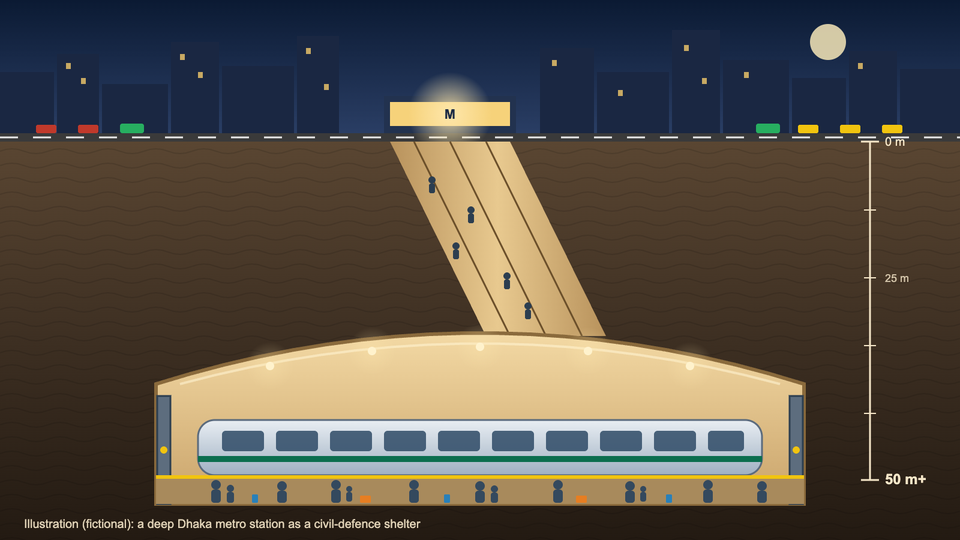
The argument in one paragraph
We should stop treating economic policy and defence policy as separate files. A metro line is the most expensive piece of public infrastructure most cities ever build, and it lasts a century. If we build it underground, and deep, the same concrete that moves a million commuters a day can also save hundreds of thousands of lives on the worst night of our history. Every major city I describe below learned this, some of them the hard way. Dhaka still has a choice.
What I saw in Istanbul (11–13 November)
From 11 to 13 November I was in Istanbul. When I landed at Istanbul Airport, I took the M11 metro straight into the city, a ride of about 30 minutes, and got off at Gayrettepe. That station is where the idea for this article took shape. Coming up from the platform to the street, I realised just how far underground I had been, and the official figures confirm it:
- Gayrettepe (M11 airport line): 72 metres below ground, the deepest metro station in Türkiye.
- Sirkeci (Marmaray): about 58 metres underground. Its southern escalators rise 61 metres, the longest in the country.
- The Marmaray tunnel under the Bosphorus: about 60 metres below sea level, the deepest immersed rail tunnel in the world, built to withstand earthquakes.
And Istanbul builds at scale. In June 2026 it completed the M11 Gayrettepe–Istanbul Airport–Halkalı line, a fully underground 69 km corridor with 16 stations. The city's urban rail network now runs to about 402.6 km, and the transport minister says it needs another 600 km to reach 1,000 km.
Istanbul's deep stations sit at 58 to 72 metres. Dhaka's first underground line has been described as running mostly 10 to 30 metres down. Istanbul sits near an active fault, and under the Bosphorus engineers had to inject grout into waterlogged, silty soil that can liquefy in an earthquake, yet they still went deep. So when someone says Dhaka's soft soil makes deep tunnels impossible, Istanbul shows that the real questions are money and political will, not engineering. Türkiye treats underground rail as permanent national infrastructure and keeps building line after line.
The lesson from Israel and Iran: shelters decide the death toll
During the 12-day war in June 2025, Iran launched more than 550 ballistic missiles and around 1,000 drones at Israel. Israeli authorities reported 28 civilians killed. That is tragic, but far lower than such a barrage could have caused, and the Israeli military itself had expected hundreds of civilian deaths. Israel's Home Front Command said that people who were inside shelters were unharmed and that the casualties were among those outside them. The sirens bought minutes; the shelters turned those minutes into survival.
Tehran had the opposite problem. Officials admitted the city had no properly equipped public shelters. Tehran had grown into a city of tightly packed high-rises without basements, and it took the authorities three days to decide to keep metro stations open overnight. Once they did, thousands of people slept on station floors while strikes landed above. Since then Tehran has officially designated 82 metro stations as shelters and is equipping them with toilets, water and food stores. Tehran learned the lesson during the war. We can learn it before one.
Ukraine: the metro that was built to be a shelter
Kyiv's metro was built in the Soviet era with a dual purpose: move people in peacetime, protect them in war. Arsenalna station sits about 105.5 metres below ground, among the deepest in the world. When Russia invaded in 2022, around 15,000 people moved into the Kyiv Metro within days, and its chief said the system could hold up to 100,000. Four years on, it is still the city's most trusted refuge: during one overnight attack in 2026, a record 52,500 people, including about 4,500 children, sheltered in the stations. Residents describe the metro as the one shelter Ukrainians truly trust.
The United Kingdom: London's Tube in the Blitz
When German bombing began in 1940, the British government initially tried to stop people using Tube stations as shelters. Londoners ignored the ban, bought tickets and stayed underground. At the peak, on 27 September 1940, about 177,000 people slept in 79 stations. Over the whole war, an estimated 63 million shelter visits were made to the Tube.
London also teaches a hard lesson about depth: direct hits on shallower stations killed 68 people at Balham and 111 at Bank. Being underground is not enough. Being deep is what counts. Another lesson: even at its peak, the Tube sheltered only around 4–5% of London's population. Capacity has to be planned, not improvised.
France: Paris designed stations as shelters
Paris went a step further and designed shelter features into stations. Place des Fêtes station, built in 1935, was conceived as an air-raid shelter, with watertight doors, a filtration chamber for outside air and swing doors in the corridors. Maison Blanche station was designed the same way. When Paris was occupied in 1940, several metro stations were fitted out to receive residents during air raids. This is exactly what Dhaka should copy: shelter capability written into the station design from day one, not added in a panic.
Spain: Madrid, where it started
Madrid was the first Spanish city to suffer sustained aerial bombardment, beginning on 4 November 1936. Terrified civilians took refuge in metro stations, in scenes that foreshadowed London a few years later. Madrid's metro became a refuge, a supply route and a lifeline, and Chamberí station, now a museum, sheltered people sleeping on its platforms during the Nationalist bombing campaigns.
Germany: turning subway stations into shelters again
Germany is the clearest warning about what happens when you let shelter capacity rot. The country has only 579 public shelters with room for about 480,000 people, less than 1% of its population, and most are not ready for use. Finland, by contrast, can shelter about 85% of its people. On 20 May 2026 the German cabinet approved a Civil Protection Pact with €10 billion in federal investment by 2029, and its core idea is to turn everyday spaces, including subway stations, tunnels and underground car parks, into a fast, decentralised shelter network. Rich, safe Germany has concluded that its metros are part of its defence.
Japan: subway stations as missile shelters
Faced with North Korean missile launches and tension with China, Japan has been designating underground stations as evacuation sites. In 2022 Tokyo designated 55 Toei Subway and 50 Tokyo Metro stations, plus underground passages. In Osaka, 108 of Osaka Metro's 133 underground stations are designated evacuation facilities. Tokyo is also converting a storage space at Azabu-Juban subway station into a dedicated missile shelter. Even so, Japan's shelter network covers only about 9% of the population, and the government is now pushing to designate more subway stations and underground arcades. If Japan, with one of the world's best metro systems, thinks it is behind, where does that leave Dhaka with almost none?
China: Beijing built its first metro for defence
Beijing's first metro line was conceived as a defence project. Construction began on 1 July 1965 under the principle of "adapting to military needs, while taking into account urban transportation". The line was built to a high civil-defence protection standard, and in early planning Beijing argued for tunnels about 60 metres deep, putting defence before transport. Today that same line is one of the busiest in the world. Defence and economics were never in conflict; one investment served both.
The Middle East: Doha and Tehran
Here in the Gulf, Doha built its metro mostly underground, with three lines (Red, Green and Gold) and 37 stations; the Gold Line alone has 11 underground stations. Qatar built it for traffic and the 2022 World Cup, but it now has a deep, hardened underground network at the heart of its capital. Tehran, as described above, is retrofitting its metro as a shelter system after discovering in wartime that it had nothing else.
Why this matters for Dhaka
- We are one of the largest cities on earth. The UN's World Urbanization Prospects 2025 puts Dhaka at about 36.6 million people, second only to Jakarta, and projects it to become the world's largest city by 2050, at about 52 million.
- We have nowhere to hide. Dhaka has no public shelter network. Like Tehran in 2025, it is a dense city of high-rises without basements built for protection. If sirens ever sound here, people will pour into the streets and create a human gridlock.
- Traffic is already a crisis. There is no alternative to metro rail for Dhaka's congestion. The only question is whether we build it in a way that also protects lives.
- We are building the first underground line right now. MRT Line-1 will run 31.24 km, with 19.87 km underground from the Airport to Kamalapur and 12 underground stations, plus two more underground stations on the Purbachal route. Construction contracts for four packages were signed with Japanese and Indian companies on 5 November 2026. Decisions about depth and station design are being locked in now.
- The design depth is still unclear. Officials have described depths ranging from about 10–30 metres along most of the route to as deep as 70 metres at Malibagh and Rajarbagh, where one tunnel will run above the other. A consistent, deep, shelter-grade standard has not been publicly set.
What we should demand
- Go deep by design. Set a target depth of 50 metres or more for tunnels and key stations, not 30. London's Bank and Balham disasters show that shallow stations can fail under direct hits.
- Write shelter features into every underground station. Blast and watertight doors, filtered ventilation, backup power, water storage, toilets and first-aid rooms, as Paris did at Place des Fêtes and Tehran is now adding.
- Plan capacity for people, not just trains. Calculate how many residents within a 10-minute walk each station can protect, and build entrances accordingly. Madrid planned shelter access so residents could reach tunnels within minutes of an alarm.
- Make it national policy. Every future line — MRT-5 North and South, MRT-2 and MRT-4 — should follow the same dual-use standard, as Beijing did from its first line.
- Pair the tunnels with a warning system and public drills. Israel's experience shows that early warnings plus disciplined sheltering are what keep the death toll low.
The honest objections
Deeper is more expensive and slower. MRT Line-1's estimated cost has already been revised up by 117.64% to about Tk 1.14 trillion, and the original December 2026 opening date has been missed. Deep stations also take longer to reach: Kyiv's Arsenalna needs over five minutes of escalators. Dhaka's soft soil and high groundwater add engineering challenges.
These are real costs, and they should be weighed openly. But the comparison is not between a cheap metro and an expensive one. It is between a metro that only moves people and one that can also save them. A shelter network built separately would cost far more and sit unused for decades. Built into the metro, it earns its keep every single day.
Conclusion
Istanbul is building underground at a scale few cities match. London, Paris and Madrid sheltered their people in their metros during war. Kyiv still does, every night of heavy attack. Germany and Japan are now formally turning subway stations into shelters, and Tehran discovered too late that it needed to. Beijing understood it in 1965.
The metro is our bomb shelter. It is also our way out of gridlock. Dhaka should build it underground, build it deep, and build it to protect the people who ride it.
Sources
- Daily Sabah / Railway News — Istanbul M11 airport line, June 2026; Wikipedia, Milliyet — Gayrettepe station depth (72 m); Anadolu Agency, Wikipedia, BPW — Marmaray tunnel and Sirkeci station depths; Türkiye Today — Istanbul rail network and 1,000 km target, Oct 2026
- Times of Israel, Aish, Airwars — Israeli casualties and shelter findings, June 2025; Jerusalem Post — IDF expected hundreds of deaths
- AP / PBS, RFE/RL, bne IntelliNews — Tehran's lack of shelters, June 2025; TRT World / Yeni Şafak — 82 Tehran metro stations designated, Jan–Feb 2026; Middle East Monitor, Sept 2026
- Ukrainska Pravda, AFP / Inquirer, Kyiv Post, Kyiv Independent — Kyiv Metro sheltering 2022–2026; Wikipedia — Arsenalna depth
- Spartacus Educational, London Museum, London Transport Museum, History.com, Google Arts & Culture (TfL archives) — London Underground in the Blitz
- Sortir à Paris, Paris Zig Zag — Place des Fêtes and Maison Blanche shelter stations
- Voices of the Spanish Civil War archive, Atlas Obscura, Wikipedia — Madrid metro as shelter
- Arab News / Reuters, Defence24, Euronews — Germany's 2026 Civil Protection Pact and shelter numbers
- Japan Times, Yomiuri / Asia News Network, Honolulu Star-Advertiser, SCMP — Japanese subway shelter designations
- Our China Story, China News, China Daily — Beijing Line 1 built for defence
- Railway Technology, Visit Qatar, Wikipedia — Doha Metro
- UN DESA World Urbanization Prospects 2025; Dhaka Tribune, Daily Star — Dhaka population
- BSS, bdnews24, TBS, Daily Star — MRT Line-1 route, depth, contracts and cost revision
Member discussion